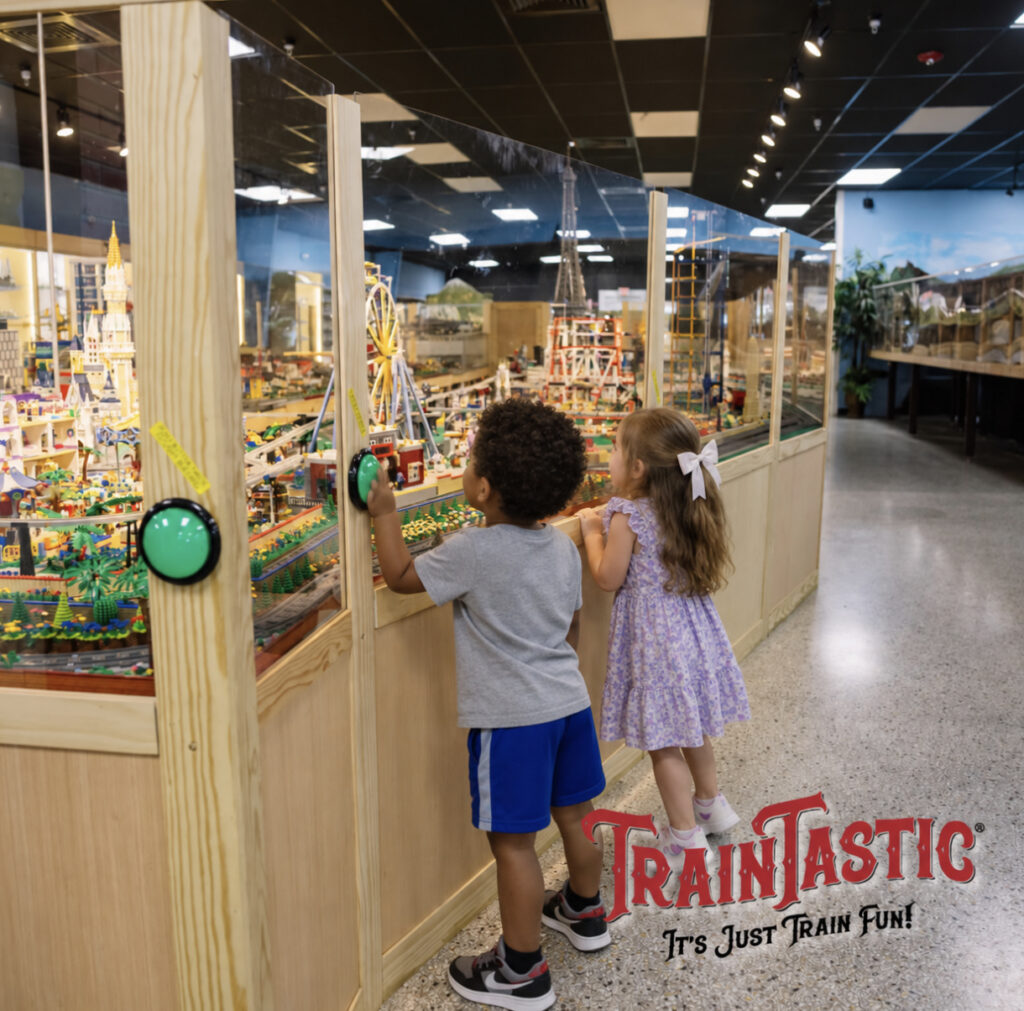
Kids get to control the trains at TrainTastic because the museum is built around hands-on, interactive play rather than look-but-don’t-touch displays. Many of the layouts include buttons, levers, and controls that let visitors blow train horns, move miniature scenes, and directly operate parts of the exhibits themselves, turning a typical model railroad visit into something kids actively participate in rather than just observe.
That design choice reflects TrainTastic’s broader approach to S.T.E.A.M. education. Rather than presenting trains and technology as something to admire from a distance, the museum treats hands-on control as the whole point.
What “Kid-Controlled” Actually Looks Like
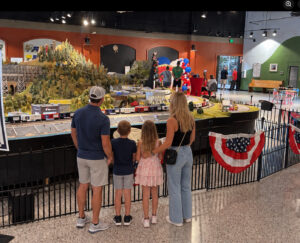
At a lot of train museums, the experience is fundamentally passive. Visitors walk past glass cases or roped-off layouts, watch trains move on a preset loop, and read placards explaining what they’re looking at. TrainTastic takes a different approach across many of its exhibits.
Throughout the museum, kids can press buttons that trigger train horns, activate sound effects, and set small scenes into motion, like a sailboat gliding across a miniature harbor. Some layouts include controls that let visitors directly influence what’s happening on the tracks, rather than just watching a train run its programmed route. One exhibit even lets kids crawl underneath a layout and pop up in the middle of a miniature train village for a 360-degree view of the scene from the inside.
This kind of design turns a visit into an activity rather than a viewing experience. Instead of a five-minute walkthrough, kids often spend real time at each interactive station, pressing buttons repeatedly, testing what different controls do, and coming back to favorite spots more than once during a single visit.
Why Interactivity Matters for Learning
There’s a reason hands-on play is central to how TrainTastic approaches its exhibits, and it connects directly to the museum’s broader S.T.E.A.M. mission. Kids tend to engage more deeply with a concept when they can manipulate it directly rather than just observe it. Pressing a button and watching a direct result, a horn sounds, a light turns on, a small scene moves, builds an intuitive understanding of cause and effect that a static display simply can’t offer.
This same philosophy carries through the museum’s dedicated S.T.E.A.M. Shop, where kids engage in hands-on science, technology, engineering, art, and math activities well beyond the train layouts themselves. The interactive train exhibits and the S.T.E.A.M. Shop work together as two versions of the same idea: learning through direct interaction rather than passive observation.
Interactive Features Throughout the Museum
A few specific examples give a sense of how thoroughly interactivity runs through TrainTastic’s design:
- Button-activated sound and motion. Many layouts let visitors trigger train horns or set small scene elements in motion with the press of a button.
- Operable train controls. Some exhibits give kids a degree of direct control over what happens on the tracks, rather than watching a preset loop.
- A crawl-through village exhibit. One display lets kids physically enter the scene and view it from a 360-degree vantage point inside the layout itself.
- Outdoor riding trains. Beyond the model layouts, kids can ride actual small-scale trains outdoors, extending the hands-on theme beyond the indoor exhibits.
- Build-your-own layout tables. Visitors can construct their own train setups at different skill levels, rather than only viewing layouts someone else built.
- A large wooden train table for younger kids. With track secured to the base and trains sized for little hands, even toddlers get a hands-on, kid-safe way to play.
How This Compares to a Typical Model Railroad Display
Traditional model railroad museums and clubs often prioritize realism and craftsmanship above interactivity, and for good reason. Many are built and maintained by dedicated hobbyists who value historical accuracy and detailed scenery work. Those displays can be genuinely impressive to look at, but they’re not always designed with a five-year-old’s attention span in mind.
TrainTastic doesn’t abandon that craftsmanship. The detail work throughout the museum, including the Coast Layout’s more than 50 interactive local landmarks, reflects real skill and care. But layering hands-on controls on top of that detail work means the museum appeals to serious hobbyists and young kids at the same time, rather than forcing a choice between realism and playability.
Why This Sets TrainTastic Apart
For families comparing train attractions, the difference between “look at the trains” and “run the trains” tends to be the deciding factor in how long a visit holds a child’s attention. A beautifully detailed but static display might earn a few minutes of admiration before a young child moves on. An interactive layout, where pressing a button gets an immediate, satisfying result, tends to hold attention far longer, and often brings kids back to the same exhibit multiple times during one visit.
This is also part of why TrainTastic tends to work well for a wide range of ages in a single stop. Younger kids can enjoy the immediate feedback of pressing buttons and watching something happen, while older kids and hobbyist adults appreciate the craftsmanship and detail underneath that interactivity.
What Parents Notice on a First Visit
Parents visiting for the first time often comment on how quickly their kids find a favorite button or control and return to it repeatedly. That repetition is a normal, healthy part of how young kids learn. Testing the same action over and over, and getting the same satisfying result each time, builds a sense of mastery that a passive display simply can’t offer.
It also changes the rhythm of a museum visit. Instead of moving steadily from one display to the next, families often find themselves circling back to favorite interactive spots, letting a child press “just one more button” before moving on. That’s a sign the exhibit is doing its job. A display kids want to return to is a display that’s actually engaging them, not just occupying their attention for a moment.
How Staff and Programming Reinforce the Hands-On Approach
The interactive philosophy extends beyond the physical layouts themselves. TrainTastic’s education programs, including field trips, Homeschool STEM Days, and workshops like the FUNdamentals of Model Railroading series, are all built around the same hands-on principle. Rather than lecturing kids about how trains or model railroading work, these programs put tools, materials, and real building tasks directly into kids’ hands.
That consistency matters. A museum that talks about hands-on learning but only delivers it in one or two exhibits sends a mixed message. TrainTastic’s commitment to interactivity shows up everywhere, from the button-activated layouts on the main floor to the structured workshops taught by staff and volunteers.
Frequently Asked Questions
Can kids actually touch and control things at TrainTastic, or is it mostly look-only?
Kids can interact with many of the layouts directly, including pressing buttons to trigger horns and motion, and in some cases directly influencing what happens on the tracks.
Is TrainTastic interactive for toddlers too, or just older kids?
Yes. A large wooden train table with track secured to the base and trains sized for little hands gives toddlers a hands-on way to play alongside the museum’s bigger layouts.
Why does TrainTastic focus on interactivity instead of just historical displays?
The hands-on approach reflects the museum’s broader S.T.E.A.M. education mission, which emphasizes learning through direct interaction rather than passive observation.
Are there build-your-own train exhibits at TrainTastic?
Yes. Build-your-own layout tables let visitors construct their own train setups at different skill levels, rather than only viewing pre-built displays.
Does the interactive design work for hobbyist adults too, or just kids?
Yes. The detailed craftsmanship throughout the museum, including the Coast Layout’s local landmarks, appeals to serious hobbyists, while the interactive controls make the same exhibits engaging for young kids.
Do TrainTastic’s education programs use the same hands-on approach as the exhibits?
Yes. Field trips, Homeschool STEM Days, and workshops like the FUNdamentals of Model Railroading series all emphasize direct, hands-on building and interaction rather than passive instruction.
Why do kids keep returning to the same interactive exhibit during a visit?
Repeating an action and getting the same satisfying result, like a horn sounding or a scene moving, helps young kids build a sense of mastery, which is a normal and healthy part of how they learn.
Plan Your Visit
At TrainTastic, kids don’t just watch the trains, they run them. Check current hours and buy your tickets today!